Hey there, fellow seekers of mathematical zen! Ever feel like life throws you a bunch of random numbers and variables, and you’re just trying to make sense of it all? Well, today we're diving into a little corner of algebra that’s surprisingly chill, all about spotting those neat and tidy perfect square trinomials. Think of them as the perfectly organized spice racks of the polynomial world – once you know what to look for, everything just… fits.
You know how sometimes you stumble upon a recipe that just works? Like, all the ingredients are balanced, and the result is pure deliciousness? That’s kind of what a perfect square trinomial is in math. It’s a special kind of quadratic expression, a three-termed polynomial, that has this inherent symmetry, this beautiful predictability. It’s like finding a perfectly symmetrical snowflake or a flawlessly arranged bouquet of flowers. There’s an undeniable elegance to it.
So, let’s ditch the stress and embrace a more laid-back approach to algebra. We’re not here to cram for a test; we’re here to appreciate the simple joys of a well-structured expression. Consider this your gentle guide, a friendly whisper in your ear, helping you identify these mathematical gems without breaking a sweat.
Unpacking the "Perfect" Part: What Makes It Special?
At its heart, a perfect square trinomial is born from squaring a binomial. Remember those? Those two-term expressions like (x + 3) or (2y - 5)? When you multiply a binomial by itself, you get a trinomial (a three-termed expression). And if you do it just right, you end up with a perfect square trinomial!
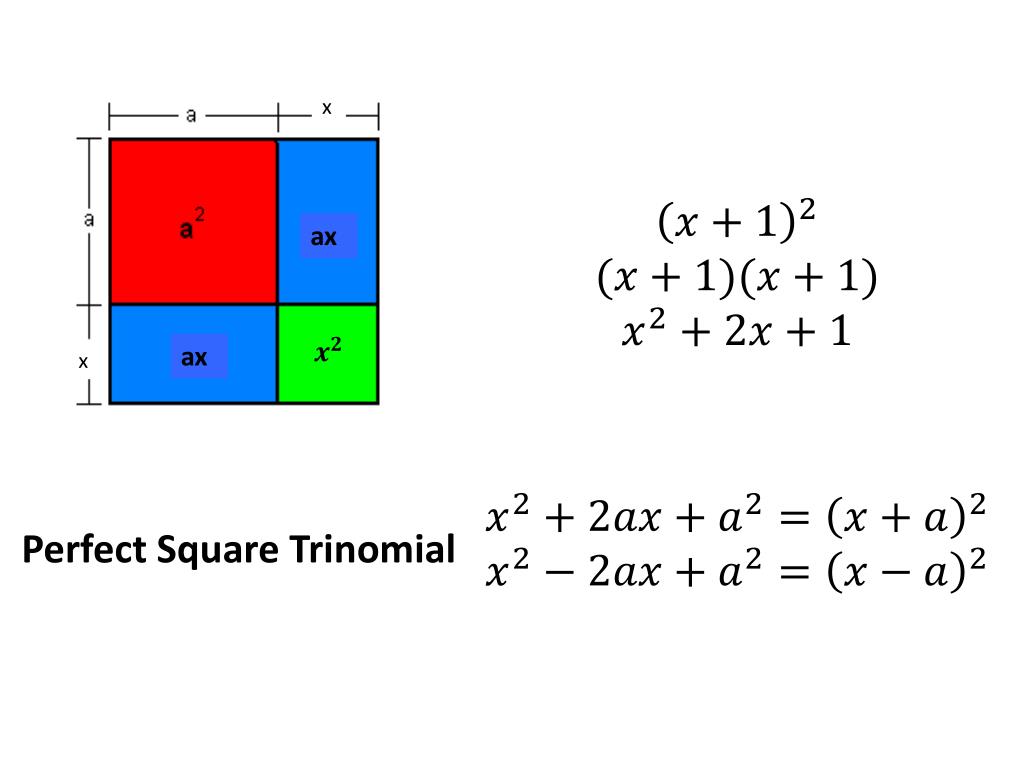
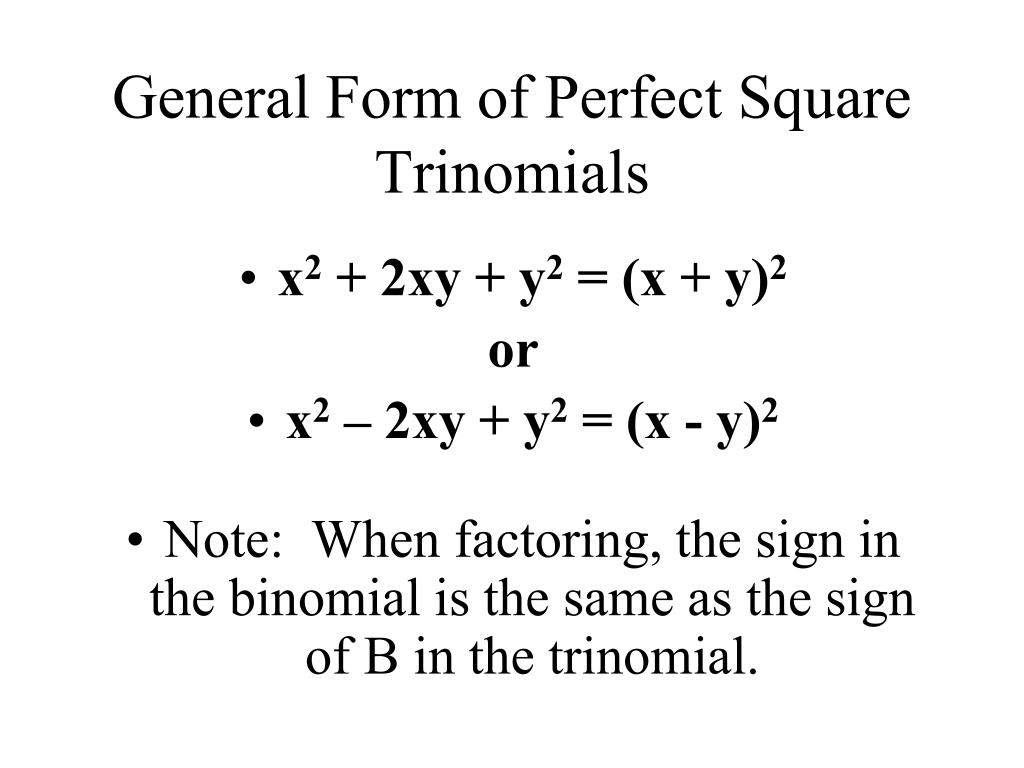
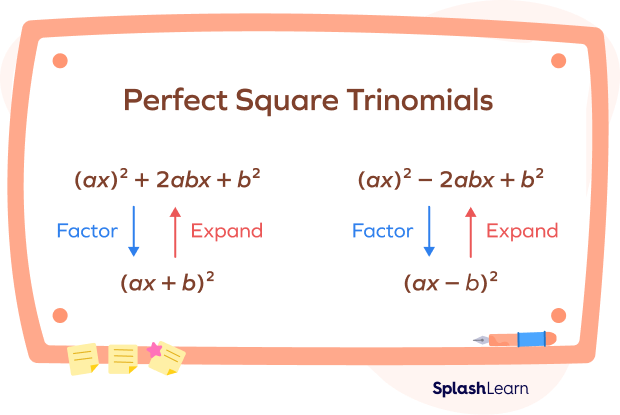
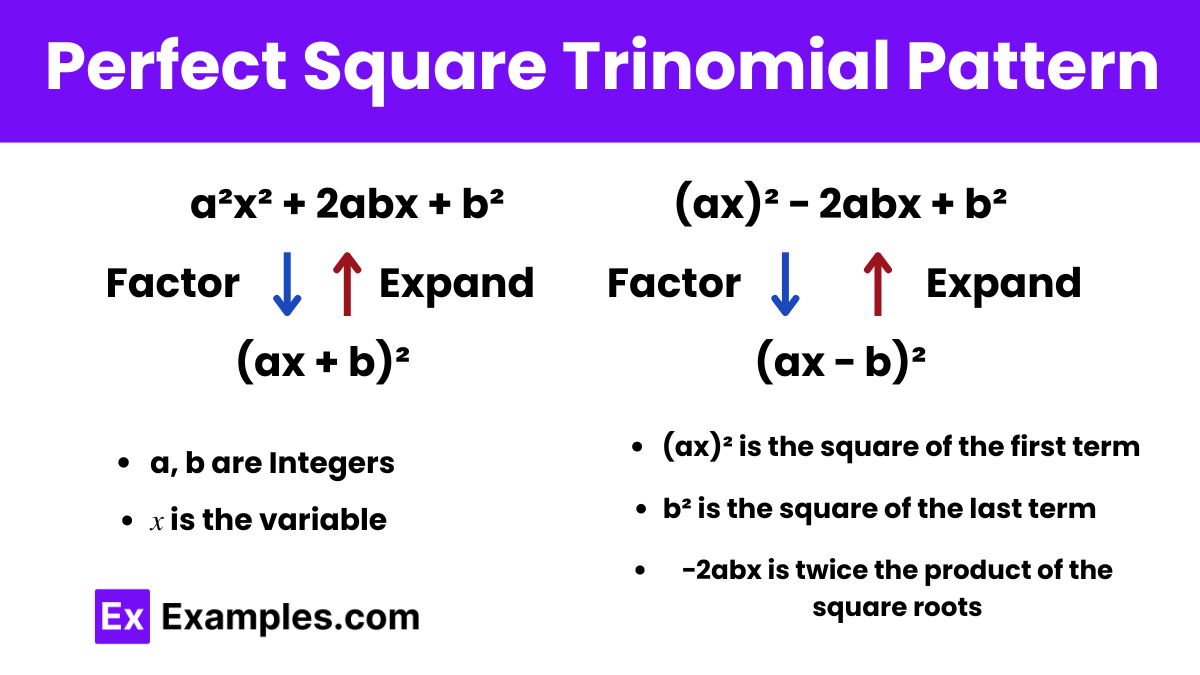
Let's break down a classic example: (a + b)². If you expand this, you get a² + 2ab + b². See that? The first term is the square of the first term of the binomial (a²). The last term is the square of the second term of the binomial (b²). And the middle term? That's where the magic happens: it’s twice the product of the two terms in the binomial (2ab).
Similarly, (a - b)² expands to a² - 2ab + b². The only difference is that the middle term is negative. This slight variation is super important, like the subtle difference between a cappuccino and a flat white – both great, but with a distinct character.
Spotting the Signs: Your Visual Clues
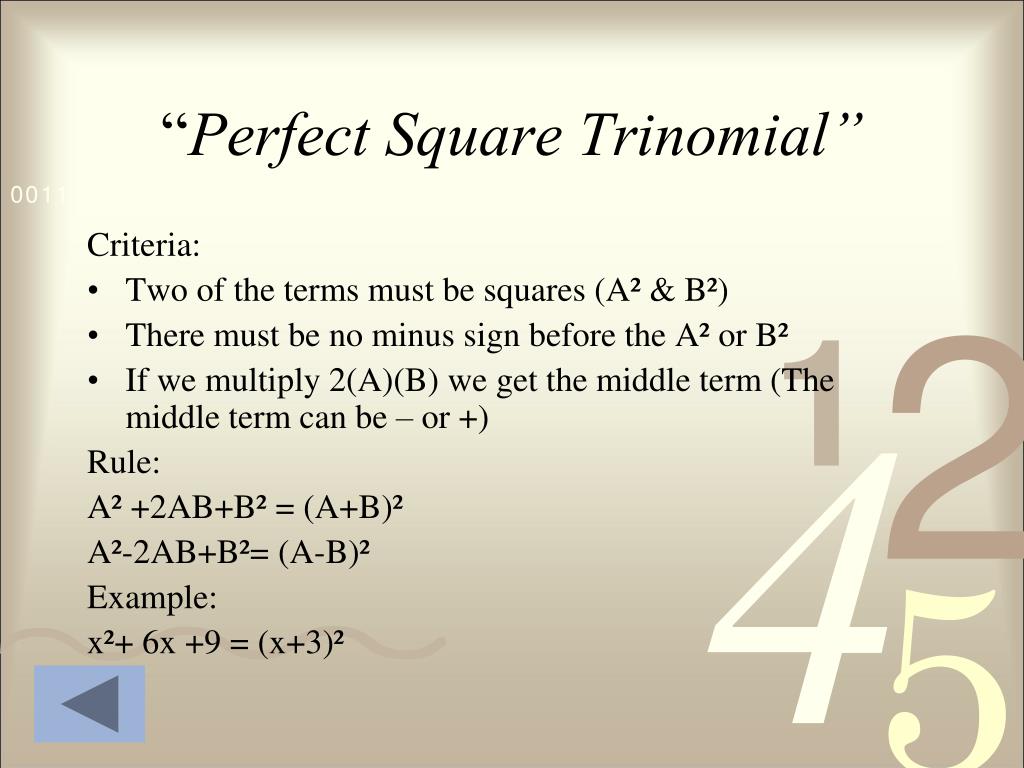
Now, how do we recognize these beauties when they’re just presented as a standard trinomial, like x² + 6x + 9, without seeing the original binomial? It’s like being a detective, looking for fingerprints and clues. Here’s your checklist:
Clue #1: The First and Last Terms Are Perfect Squares.
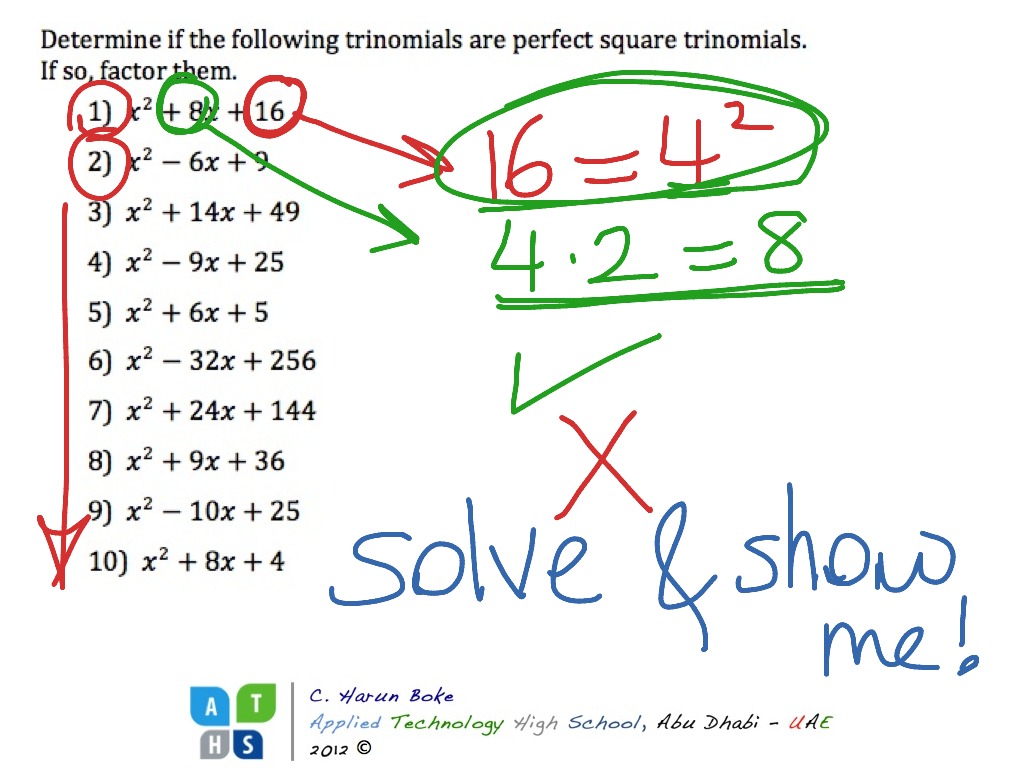
This is your primary giveaway. Look at the first term and the last term of the trinomial. Are they perfect squares? For instance, in x² + 6x + 9, x² is the square of x, and 9 is the square of 3. Easy peasy.
Think of it like this: if you were building with LEGOs, you’d want to start with perfectly square or rectangular base plates, right? These first and last terms are your foundation. If they’re not perfect squares, then this trinomial likely isn't a perfect square trinomial. No drama, just move on to the next one!
Clue #2: The Middle Term is Twice the Product of the Square Roots.
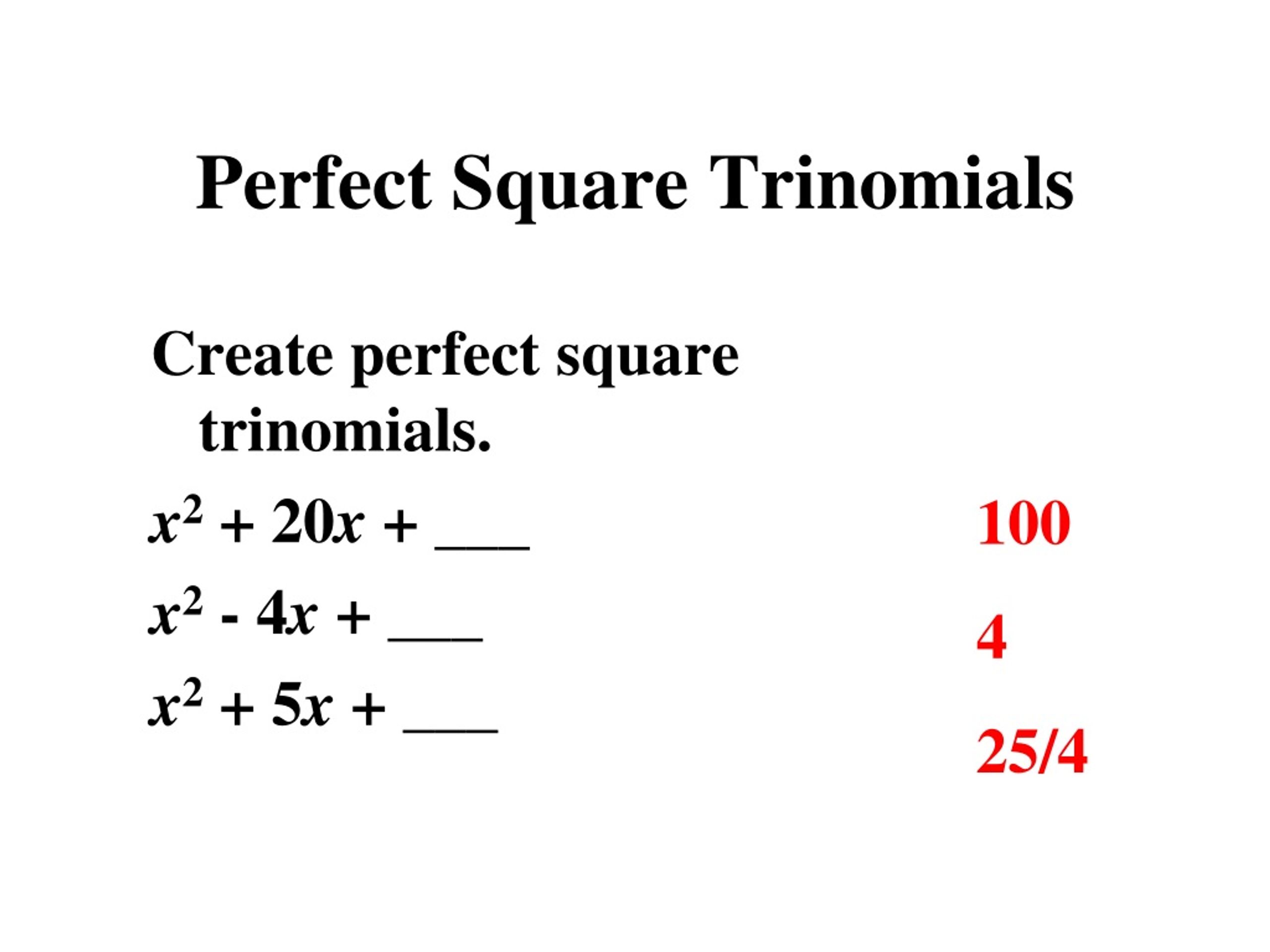
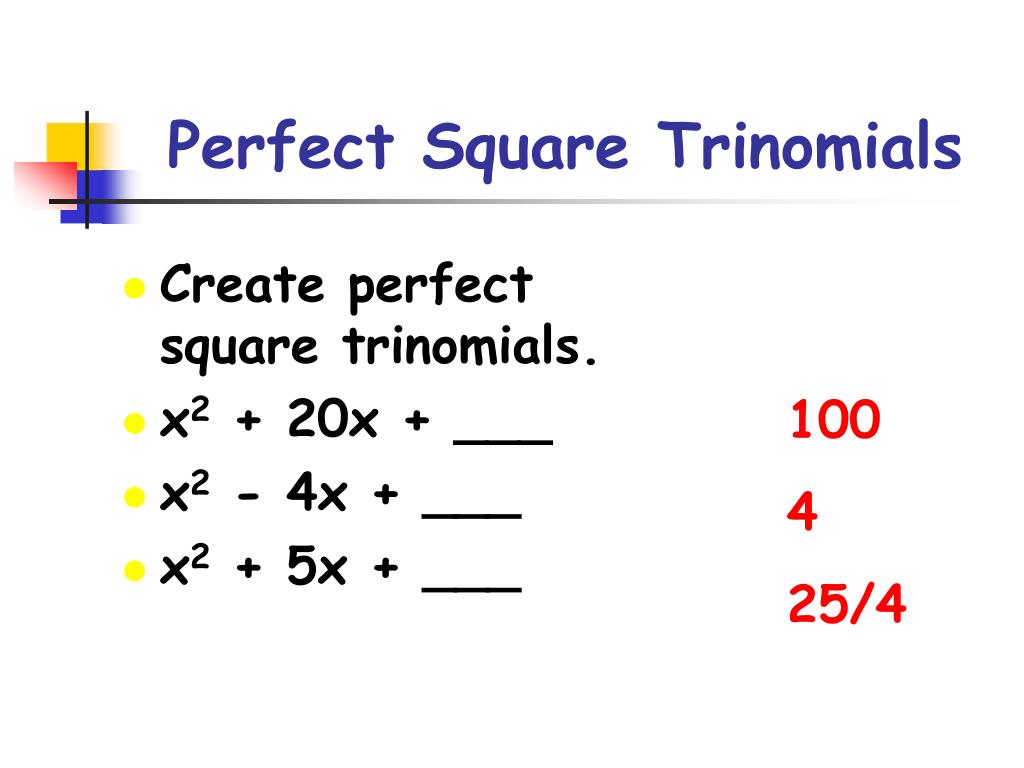
This is the real test. Take the square root of the first term and the square root of the last term. Multiply them together. Then, multiply that result by 2. Does it match the middle term of your trinomial?
Let's revisit x² + 6x + 9. The square root of x² is x. The square root of 9 is 3. Multiply them: x * 3 = 3x. Now, multiply by 2: 2 * 3x = 6x. Bingo! It matches the middle term. This trinomial is a perfect square!
What about the sign of the middle term? If the middle term is positive, the original binomial was likely of the form (a + b). If the middle term is negative, it was likely of the form (a - b).
When to Use This Superpower
Okay, so we can identify them. But why bother? Well, recognizing perfect square trinomials is a shortcut, a cheat code for factoring. Instead of going through the whole song and dance of finding factors, you can instantly factor it into (square root of first term + square root of last term)² or (square root of first term - square root of last term)².
Imagine you’re trying to solve a tricky puzzle. Knowing that a certain piece is a perfect square trinomial is like having the key to unlock a whole section of the puzzle instantly. It saves you time and mental energy, allowing you to focus on the bigger picture. It's the equivalent of knowing the secret handshake or the VIP entrance.
A Quick Example to Seal the Deal:
Let's take 4y² - 20y + 25.
Step 1: Check the ends. Is 4y² a perfect square? Yep, it's (2y)². Is 25 a perfect square? You got it, it's 5².
Step 2: Check the middle. Take the square roots: 2y and 5. Multiply them: (2y) * 5 = 10y. Double it: 2 * 10y = 20y.
Step 3: Compare and confirm. The middle term of our trinomial is -20y. Our calculation gave us 20y. Since the middle term is negative and matches the doubled product, this trinomial is a perfect square. The original binomial was (2y - 5). So, 4y² - 20y + 25 = (2y - 5)². Boom! Factored in a flash.
Beyond the Classroom: Real-World Vibes
You might be thinking, "Where in my everyday life will I ever need to factor a perfect square trinomial?" And that’s a fair question! While you won’t be whipping out your algebra skills at the grocery store, the concept of recognizing patterns and leveraging shortcuts is everywhere.
Think about cooking. Once you’ve mastered the basic techniques, you can easily adapt recipes. You recognize the "perfect square trinomial" of a basic sauce, and you know you can add different herbs or spices to create variations. Or in music, once you understand chord progressions, you can improvise and create new melodies. It’s about understanding the underlying structure.
Even in design, symmetry is a powerful tool. Architects and graphic designers often use perfect squares and rectangles because they’re pleasing to the eye and create a sense of balance. Perfect square trinomials, in a way, represent this mathematical symmetry and balance.
Fun fact: The golden ratio, often found in art and nature, is also connected to mathematical sequences that exhibit a kind of predictable harmony. While not directly a perfect square trinomial, it speaks to our innate appreciation for mathematical elegance.
A Little Cultural Dive: The Beauty of Repetition
The idea of something "perfectly squared" or repeated has resonated throughout cultures for centuries. Think of mandalas in Buddhism, intricate geometric patterns in Islamic art, or even the rhythmic repetition in poetry and music. There's a calming, almost meditative quality to recognizing and creating these balanced forms.
Perfect square trinomials are the algebraic equivalent of that satisfying click when puzzle pieces fall into place, or when a musical phrase resolves perfectly. It's a small moment of order in a potentially chaotic world.
When It's Not a Perfect Square: No Worries!
It's also super important to remember that most trinomials aren't perfect squares. And that's totally fine! Life isn't always perfectly symmetrical. This is where other factoring techniques come into play, like finding common factors or splitting the middle term. The beauty of math, like the beauty of life, lies in its variety and the different tools we have to navigate it.
Don't get discouraged if a trinomial doesn't fit the perfect square mold. It just means it's a different kind of puzzle, one that requires a different approach. Embrace the diversity!
The Takeaway: Finding Your Algebraic Flow
So, there you have it – your easy-going guide to perfect square trinomials. It’s not about memorizing rigid rules; it’s about developing an eye for patterns, understanding the underlying structure, and appreciating the elegance of a well-formed expression.
Think of it as adding another useful tool to your mental toolkit. The more you practice spotting these, the quicker and more intuitive it becomes. It’s like learning to ride a bike; at first, it takes effort, but soon it becomes second nature.
In the grand scheme of things, this is a small, yet powerful, piece of the algebraic puzzle. And by understanding it, you’re not just mastering math; you’re honing your ability to recognize order, structure, and efficiency – skills that are incredibly useful, no matter where life takes you.
Daily Life Reflection: The Art of Predictability
You know, this whole idea of "perfect square trinomials" reminds me of how we unconsciously seek out predictability and order in our daily lives. We have routines for our mornings, favorite routes to work, and even preferred ways to arrange our kitchens. These aren't about being rigid; they're about creating a sense of calm and efficiency.
When we can quickly identify that our morning coffee ritual, just like a perfect square trinomial, is reliably going to give us that comforting boost, it frees up our mental space. We don't have to "factor" our morning every single day. We know the pattern, we know the outcome, and we can focus on the slightly more unpredictable, yet equally rewarding, aspects of our day.
So, the next time you encounter a trinomial that looks like it might be a perfect square, take a moment. Appreciate the elegance. Recognize the pattern. And remember that sometimes, the most satisfying moments come from understanding a simple, yet beautiful, form of mathematical harmony. It’s a little reminder that even in the abstract world of algebra, there’s a certain, dare I say, perfect kind of order to be found.